Balance recognition, model alignment, PPE prompts, and spatial guidance are demonstrated in the current prototype.
 A VARLIS™ project
AI-guided mixed reality on the real instrument.
Parallax anchors an approved procedure to physical equipment: show the next action, verify defined checks, and keep the operator in control.
AI-assisted guidance
Working Quest 3 prototype
Scientific instruments
Prototype capture
One balance workflow with defined step checks and an evaluation shaped with a technical partner.
Approved procedure logic controls progression; AI may explain context but does not operate the instrument.
The idea
Put on the glasses. Complete the procedure with expert guidance.
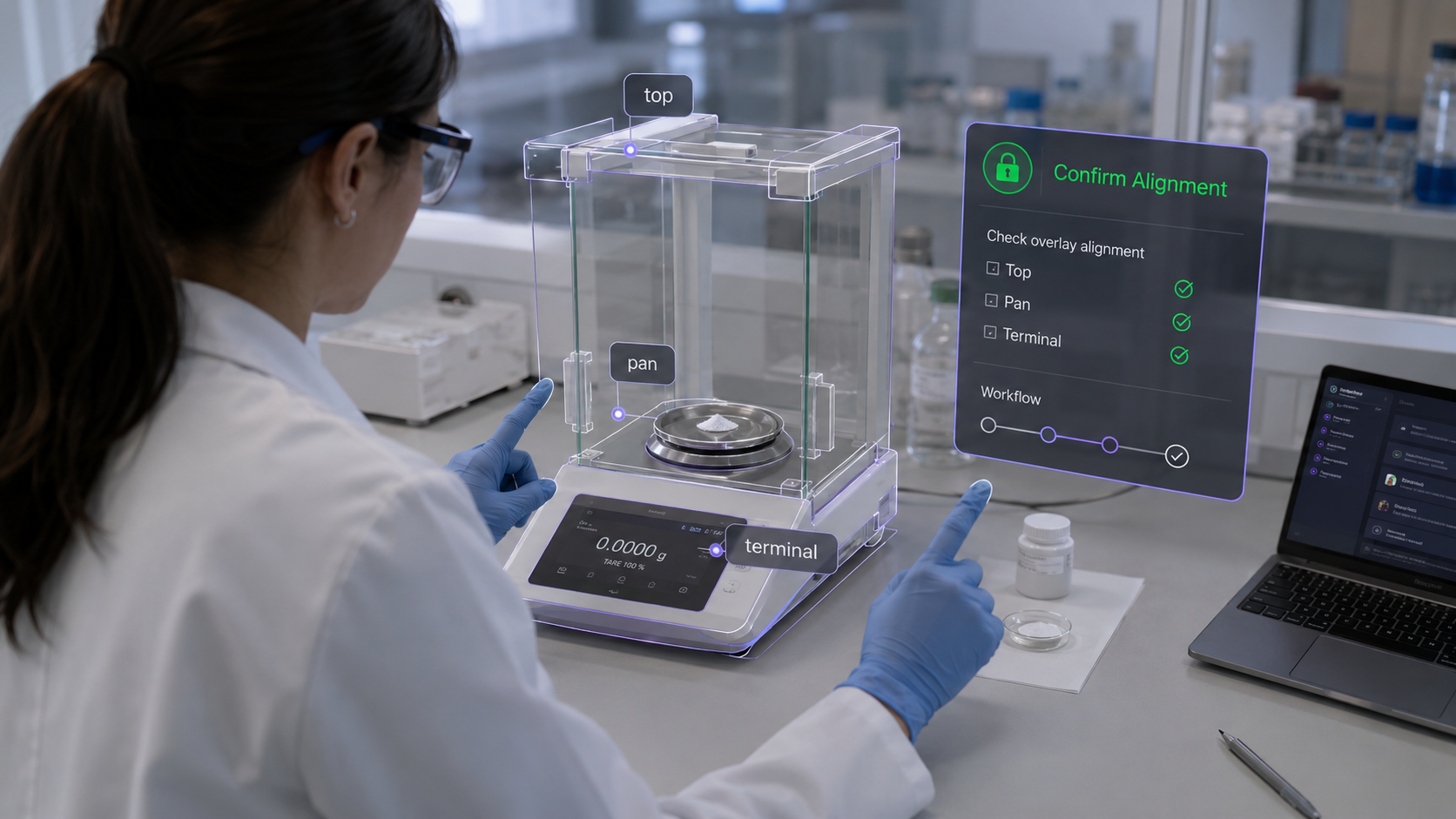 AI concept render
Glasses that recognise the equipment in front of the operator, overlay the next approved action, and verify defined physical checks before the workflow progresses. The operator stays in control; the approved procedure leads.
- Real-time, in-the-moment assistance - not training for later
- Extends expert guidance to where an expert isn't on site
- Developed first around analytical instruments and their procedures
Already working
A live mixed-reality build on Quest 3 today.
The prototype already demonstrates the core loop: recognise the balance, align a 3D model to the real device, ask for hands, check glove state, prompt when a requirement is missing, and proceed only when the operator is ready.
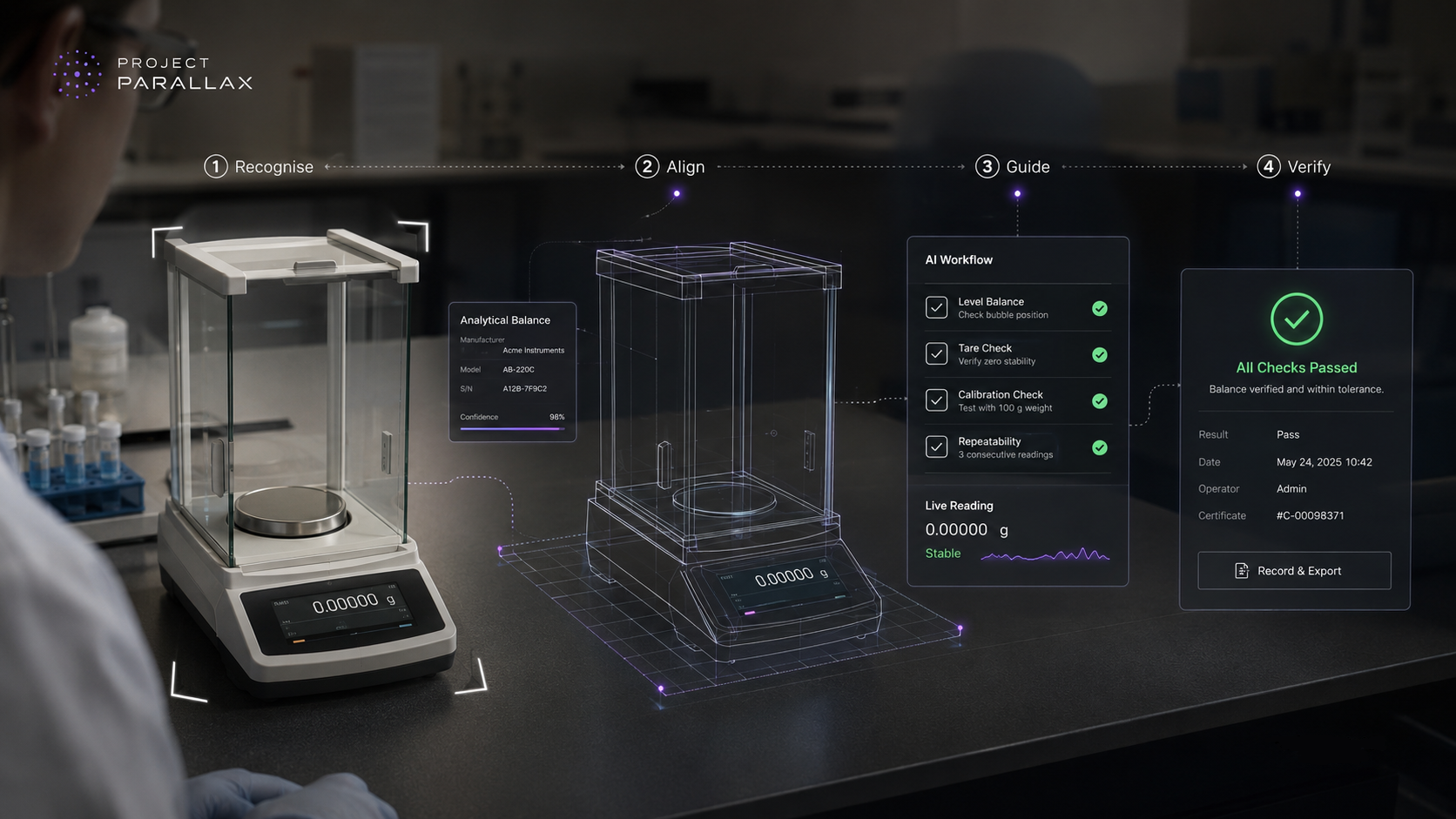 AI concept render
Quest 3 prototype
See once, then track.
After registration, continuous vision is not the goal. The system knows where the instrument is and tracks hands relative to known geometry, invoking vision only for brief, specific checks.
- Balance recognition and model alignment
- Glove / PPE prompt and confirmation
- Spatial workflow guidance in the operator's view
- Next target: full calibration with step-level assessment
Domain advantage
Built from inside the instrument.
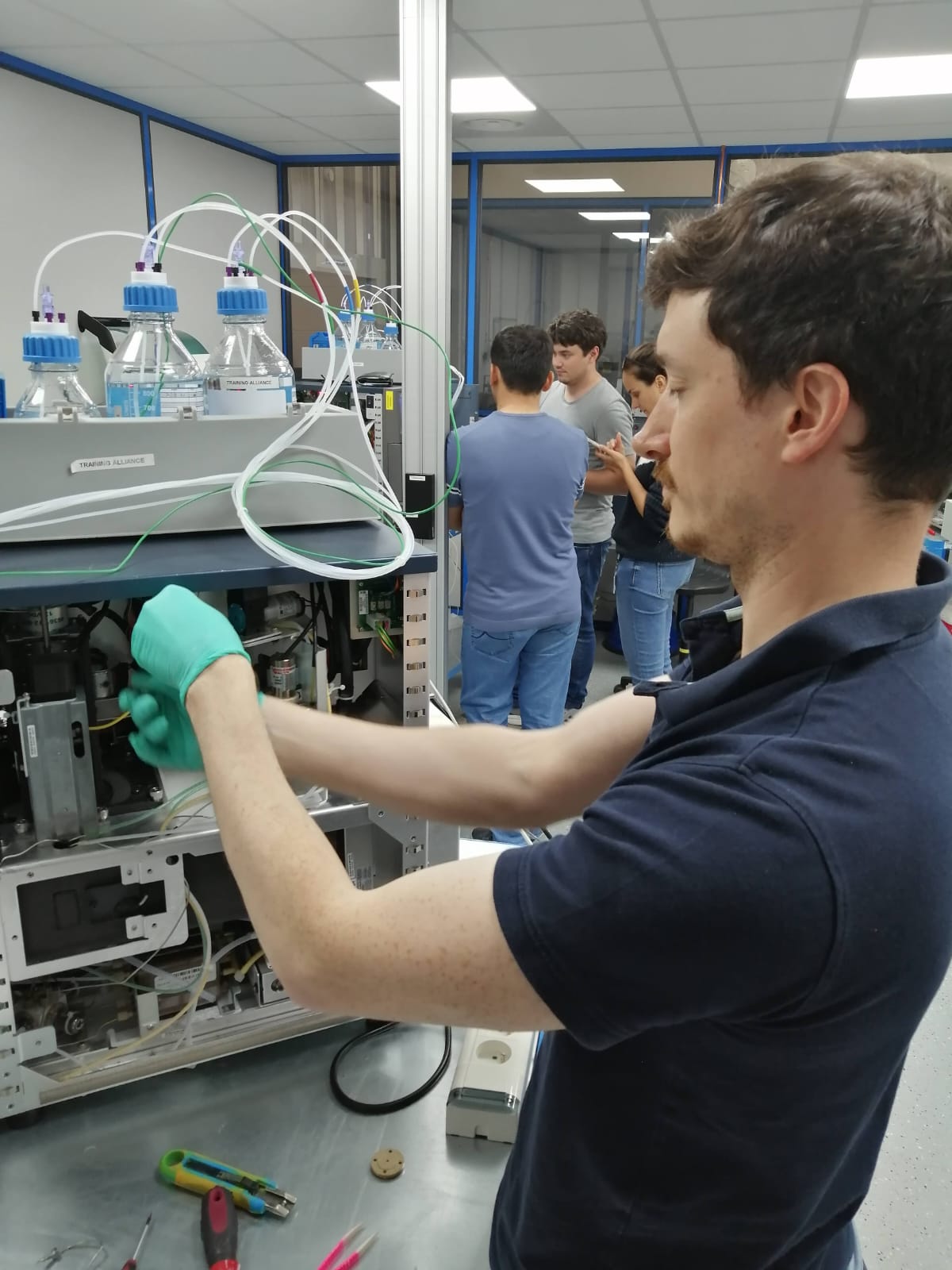
Science, engineering, and software
Built by someone who has trained, supported, and worked on the instruments.
Parallax is being built by Guy Entract, PhD - a former scientific-instrument applications specialist with pharmaceutical laboratory experience and formal manufacturer training on Waters, Mettler-Toledo, and Malvern Panalytical systems.
That background makes it possible to model more than an instrument's appearance: how its components behave, where procedures fail, which cues matter to the operator, and which decisions must remain inside approved procedural control.
Manufacturer names describe professional training experience, not VARLIS customers or endorsements. Read the background →
Architecture
See briefly, then track. Deterministic logic, separate AI layer.
Parallax separates approved procedure logic from contextual AI assistance. The workflow defines what must happen and what permits progression; AI can explain and retrieve in context without changing that path.
Find the instrument
Small vision models identify the instrument and the key features needed for spatial registration.
Align the model
A 3D representation is matched to the real object, with confirmation and fine-tuning available to the operator.
Verify each step
Procedure data defines the instruction, verification rule, and progression gate for each approved action.
Answer in context
A separate AI guidance layer can answer questions from approved content without changing the validated workflow path.
Safety & compliance
Assistance, not control - with a traceable workflow record.
For laboratories and regulated technical work, the line is deliberate: the software supports the user and records workflow events; it does not operate the instrument on the user's behalf.
The human always acts.
Parallax can tell the operator what comes next, point to the right physical area, and confirm that a defined condition appears to be satisfied. It does not press buttons, change parameters, or send commands to the instrument.
Designed to support auditability and privacy.
The intended record is a workflow event trail: what step was reached, what check passed, what prompt was shown. The default design avoids retaining continuous camera footage unless a customer policy requires otherwise.
Have a procedure that needs real-time guidance?
The strongest first conversation is about one instrument, one approved procedure, and the physical checks that matter. Parallax is being shaped toward a partner evaluation of a complete balance-calibration workflow.
Technical direction and platform notesLaboratory-context architecture, development path, device port, and wider applications
The wider system
From understanding one instrument to understanding the laboratory.
Parallax begins where digital records meet physical work. Its longer-term direction is a shared spatial and semantic representation of the laboratory: what equipment is present, how its components relate, what procedure is underway, what observable state the instrument is in, and what evidence each action produces.
Spatial model
The laboratory, instruments, components, hands, samples, consumables, and tools represented as related objects.
Instrument state
Readings, configuration, calibration, and maintenance signals where approved interfaces or sensors permit.
Procedure state
The approved SOP version, current step, required checks, progression gates, and authorised exceptions.
Results & evidence
Operator actions, readings, outputs, timestamps, exceptions, and provenance joined to the work that produced them.
One model of what is here, what state it is in, and what is happening now.
Contextual AI can retrieve, explain, compare, and guide across this model. The deterministic procedure layer remains authoritative, and the scientist remains responsible for every physical action.
Human interface
Project Parallax
Guidance anchored to the real instrument, delivered in the operator's view at the moment it is needed.
A staged path from prototype to product category.
One instrument, core guidance loop
A Quest 3 prototype for balance recognition, model registration, PPE checks, and spatial guidance.
One procedure, deeply connected
One deeply modelled instrument and approved procedure connected to defined operational readings and a coherent workflow evidence record designed to support auditability.
Laboratory-wide context
People, instruments, procedures, results, and compliance evidence connected through one AI-assisted spatial and semantic interface.
The objective is not AI independently controlling the laboratory. It is AI that comprehends the current laboratory context and helps the scientist make the correct next decision.
Platform & port
Built on Quest 3, aimed at optical see-through glasses.
The existing Unity prototype gives the project a practical base. The next step is an Android XR / XREAL Aura version tuned for optical see-through display, camera availability, and enterprise deployment constraints.
Unity, a port not a rebuild
The prototype is already Unity, a first-class Android XR route via OpenXR. The procedure engine, AR UI, model-alignment logic, and content approach carry across.
Provider, see-through, camera
The device-specific work is the Android XR provider swap, re-tuning overlays for optical see-through, and validating the brief camera-capture checks.
Pilot-ready enterprise app
The aim is a pilot-ready Android XR application for a validated workflow, delivered through enterprise or managed distribution.
The scope
Analytical instruments are the proving ground.
The first workflow is a balance calibration path because that is where the domain expertise and prototype are strongest. The same pattern extends to other work where a complex procedure must be completed correctly and an expert is not always on site.
Instrument setup, calibration, sample preparation, and compliance checks.
Guided installation, maintenance, and escalation support for approved service tasks.
Assembly and maintenance procedures checked in real time.
Future applications subject to domain validation, risk assessment, and appropriate partners.