Agree the instrument, important procedure, intended learners, and training problem.
Train scientists before they touch the real instrument.
VARLIS™ reproduces the instrument, its controls, and the workflow around it so customers and technical teams can rehearse critical procedures safely. Begin with one instrument and one important procedure.
Need guidance on the physical equipment during work? See Project Parallax →
Working training example
A complete precision-balance calibration workflow.
A precision-class research balance is reproduced inside the VR laboratory with its controls and calibration interface. The learner practises the procedure in sequence before working on expensive physical equipment.
What the learner does - and what the trainer can evaluate.
The learner opens the draught shield, handles the calibration weight, follows the instrument software, and reads the result. An instrument-specific pilot can define which actions, decisions, and outcomes matter to the customer's training team.
- Rehearse the complete procedure in the correct sequence
- Practise physical handling without risking the real balance
- Respond to instrument controls and software cues
- Evaluate agreed steps and outcomes with the training team
A focused first project
Start with one instrument and one procedure.
An initial project is scoped with the customer's training team. The objective is a useful, evaluable module - not a commitment to a whole platform before the workflow has proved its value.
Name the technical reviewer and the approved manuals, SOPs, interfaces, and reference material.
Define the supported setup, interactions, assessment rules, and commercial scope.
Run the module with trainers or users and decide what evidence would justify a wider rollout.
Domain credibility
Built by Guy Entract, PhD.
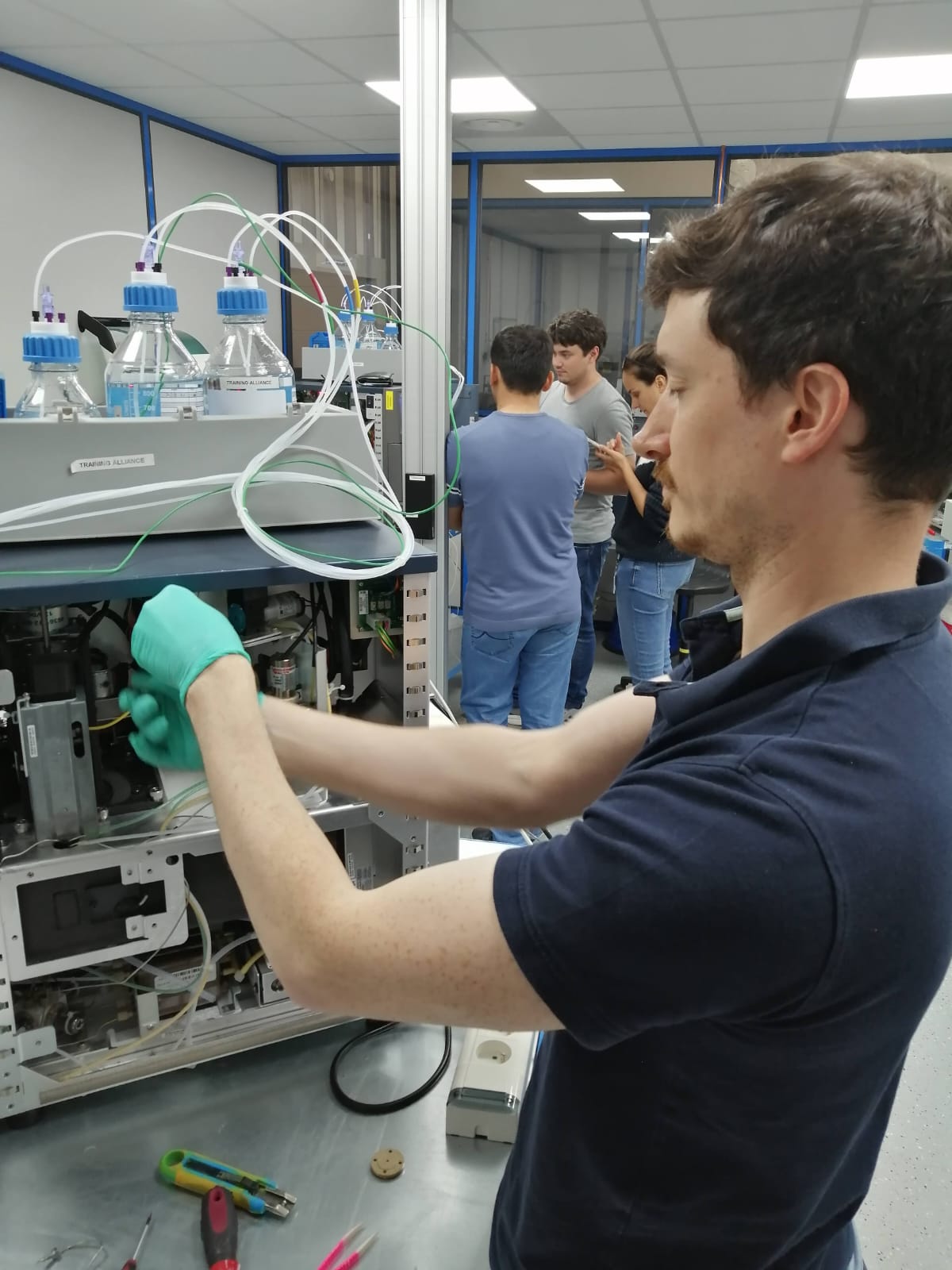
Manufacturer-trained scientist and former applications specialist.
Guy's background spans PhD chemistry, pharmaceutical laboratories, scientific-instrument applications, installation, training and support, plus end-to-end work in Blender, Unity, XR, and software development.
Formal manufacturer training includes Waters, Mettler-Toledo, and Malvern Panalytical systems. These names describe professional training experience, not VARLIS customers or endorsements. Read the background →
Scientific simulation
Make the hidden physics visible.
A triple-quadrupole tandem mass spectrometer is modelled on the bench with particles travelling through it and a spectrum that responds as the trainee changes RF and DC parameters.
See cause and effect respond to your hands.
Instead of asking learners to trust an abstract diagram, the simulation lets them alter a parameter and see the spectrum and particle behaviour respond in real time.
- Live particles through all three quadrupoles
- Spectrum updates as voltages change
- Physical on-bench control boxes
Production craft
Built for scientific fidelity and standalone VR.
Geometry, lighting, UVs, textures, labels, and interfaces are authored to look credible while remaining practical on mobile XR hardware.
Detail with a performance budget.
Assets are built from scratch to preserve the visual and procedural cues scientists notice without sacrificing a comfortable standalone-headset framerate.
- Lean hand-built geometry
- Baked lighting and authored UVs
- Interfaces and labels matched to the workflow
Shared and remote
Bring the trainer into the same virtual laboratory.
Shared sessions can support guided demonstrations and training between an instructor and learner who are not in the same building.
Practise together, from different locations.
A technical trainer can demonstrate the workflow while the learner works through the same instrument and procedure in the shared environment.
A separate offer
Need guidance on the real instrument?
VR training is for rehearsal before the procedure. Project Parallax is the separate mixed-reality route for step-by-step guidance on physical equipment during the work itself.
Project Parallax™
A working Quest 3 prototype demonstrates instrument recognition, model alignment, PPE prompts, and spatial guidance. The next product milestone is a complete calibration procedure with step-level assessment.
Which instrument procedure is hardest to teach well?
Start with the workflow, the intended learners, and the evidence your training team would need to judge whether an instrument-specific module is useful.
Discuss your training workflow